Gussie
Mariners' Museum, Uncurated Search Results
Type: Skipjack
Year: 1899
Builder:
Location: Oriole

These records are found in the online catalog of The Mariners’ Museum and Park in Newport News, Virginia. Uncurated search results are presented to give researchers and interested readers an idea of whether the museum’s archives contain information about this vessel and whether it may be worthwhile to visit the museum’s catalog search page for further investigation. Uncurated results may be inaccurate or incomplete.
Search mode: Exact Name. Search phrase(s): "Gussie". Results returned: 12. Results displayed in this table: 12.
Use these buttons to send uncurated search results to your own app or text document for further research. First, check the box for any row, or click "Select All" then uncheck any rows. Then click "Show Selections". You can then copy your selections from the text box and past them into your app.
| Fetch? | Row ID | Media | Date | Vessel | Place | Related Places | Inscription/Marks | Subject | Notes | Archive Number |
|---|---|---|---|---|---|---|---|---|---|---|
| 1 | 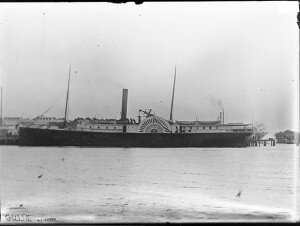 | circa 1910 | Gussie (Side wheel steamer : 1872). | Steamboats–United States.; Bodies of water–United States. | Shows the side wheel steamer Gussie under way. | MS0095/02-#607 | ||||
| 2 | 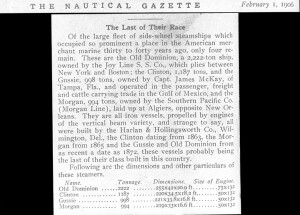 | 1883-1931 | Gussie (Side wheel steamer : 1872).; Old Dominion (Side wheel schooner : 1872).; Clinton (Side wheel steamer : 1863).; Morgan (Side wheel steamer : 1865). | Gussie/Unk/Unk/Text describing history of side whe[eel] | Copy of a newspaper clipping titled "The Last of Their Race". Discusses steamships Old Dominion, Clinton, Gussie, and Morgan as the last remaining paddle steamers in the United States. | MS0091/03.01-24#019 | ||||
| 3 | 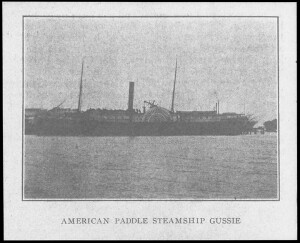 | 2/1/1906 | Gussie (Side wheel steamer : 1872). | "Gussie"/1872 Morgan Line (later/Venz. "Venezuela")/"Old Dominion"/1872Old Dominion Steamship Co.; photostat neg./"Last of Their Race"; Nautical Gazette;/Feb. 1, 1906 | Copy of a newspaper illustration of the side-wheel steamer Gussie from the Nautical Gazette. | MS0091/03.01-24#016 | ||||
| 4 | 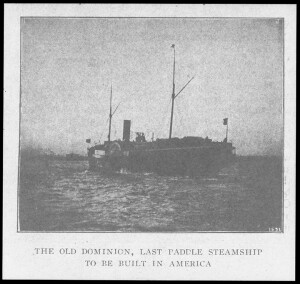 | 1883-1931 | Gussie (Side wheel steamer : 1872).; Old Dominion (Side wheel schooner : 1872). | Gussie/1872/Unk/Stern View Distant View | Copy of a newspaper illustration of the steamer Gussie. The news article discusses the steamer Old Dominion, as the last paddle steamer to be built in America. | MS0091/03.01-24#018 | ||||
| 5 | 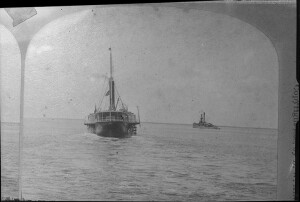 | 1883-1931 | Gussie (Side wheel steamer : 1872). | Gussie/1872/Unk/Broadside Distant View | Copy of half of a stereograph of a behind view of the paddle steamer Gussie, moving away from camera. | MS0091/03.01-24#017 | ||||
| 6 | 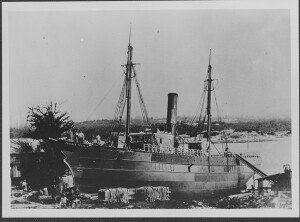 | 1883-1931 | Gussie Telfair (Screw steamer : 1866). | Gussie Telfair/4x5 black and white/shoot date unknown/photographer unknown | Port side of the steamer Gussie Telfair at dock. | MS0091/03.01-24#020 | ||||
| 7 | 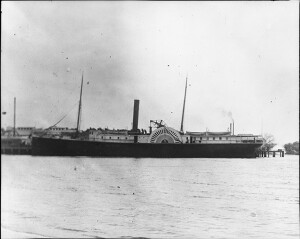 | 1883-1931 | Gussie (Side wheel steamer : 1872). | "Gussie" (1872-), later "Venezuela" (Ven.), Morgan Line | Steamboats–United States.; Paddle steamers–United States.; Harbors–United States. | Shows a port side view of a side wheel steamer moored in a harbor. | MS0091/03.02-02#1338 | |||
| 8 | 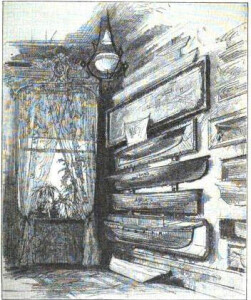 | SHORT DESCRIPTION: Builder’s half hull model, starboard side, made by George Steers of the sloop Gussie. The model is a basic representation of the vessel's molded lines, without constructional details. The model is not mounted on a backing board. The bottom eight lifts were painted red then covered with a layer of gold colored paint and then varnished; the top three lifts i are painted blackish-green with varnish over top. At the lift comprising the deck is painted black. It is inscribed in gold “GUSSIE” with three decorative flourishes to each side. The model has a raked stem with a bend at the top where a bowsprit might be installed. The upper stern is sharply raked and hour-glass shaped. There is no counter and no stern post. A 6” section of the keel at the center of the model is flat and curves upwards towards the bow and stern. The keel essentially stops at the bottom of the upper stern. It has steep deadrise and little or no tumblehome. There is a curved rocker beginning 15” back from the bow. It has a short, slightly concave entry and a short run aft. 15” from the stern the keel begins curving upwards making it appear that there is no stern post. The model is constructed of 12 lifts. The lower 8 lifts are flat, arranged in pairs. The bottom lift is 11/16" lift of pine and a 1/32" lift of a darker wood, probably cedar. Lifts 3 through 8 consist of pairs of a 9/16” lift of pine and a 1/31” lift of a darker wood, probably cedar. The sheer curve is cut into the 9th lift. It is 9/16” amidships, 1-3/4” at the stern, and 1-7/8” at the stem. Lifts 10 and 12 are 1/32” and curve with the sheer. Lift 11 tapers from 11/16” at the bow to 7/16” amidships to 3/16” at the stern. Lift 12 is the top covering of the model, which is not hollowed out to deck level. The dimensions of the model are 35-3/8” (length overall); 6-1/8” (main breadth), 6” (half breadth), leaving a tumblehome of just 1/8”. Height overall is 4-11/16”. The minimum half-breadth of the model is 3/32" along the edge of the stem and at the stern. The keel, amidships is a flat and 3/8” deep (measuring across the flat area from the back of the model to the bend). The lifts are held together with five wooden pegs that run from top to bottom. The holes are filled with colored wax. The peg closest to the bow is visible on the face of the model as a rectangular section of wood. The insertion of that peg appears to have caused losses to the surrounding wood. There are a few variously sized holes whose purpose is not apparent on the top and back of the model. The model is in good overall condition. The varnish is stable. There is some traction crackle on the painted layers. There is a deep scratch on the bottom lift slightly towards the bow from amidships. There are some minor wood losses at the bow and stern on the top of the model. Lift 7 is missing a small piece of wood at the stern. The number 17 has been handwritten on the reverse (its unclear what this number refers to). There is a separation between lifts 8 and 9. ADDITIONAL INFORMATION: See Yachts and Yachting with over One Hundred and Ten Illustrations, by Fred S. Cozzens and Others, 1887, image page 56, references on page 37. NOTES: The collection of half models MR 5 through MR 24 are of vessels built by shipbuilders Henry (father), James Rich and George (sons), and Henry Steers (son of James Rich), builders of the famous yacht America. The models document vessels built between 1805 and approximately 1876. They encompass all types of vessels from a catboat up to large steam sloop built for the US Navy. In a February 13, 1963 letter Howard I. Chapelle, Curator of the Division of Transportation at the Smithsonian stated “The Steers Collection is important technically and it is something we envy the Mariners’ Museum’s possession.” VESSEL INFORMATION- VESSEL NAME: Gussie (1867-1886), Paulina (1886-1897), Gypsy (1897-1907) VESSEL TYPE: Centerboard sloop DESIGNER: Henry Steers SHIPBUILDER: Henry Steers (registers) or J. W. Conklin (Brooklyn Union) SHIPBUILDER LOCATION: Greenpoint, New York SHIPOWNER: Henry Steers (1867-1871), S. Whitney (1871-1872), J. D. Fowler (1872-1875), G. W. Root (1886-1897), ? (1897-1907) BUILD DATE: 1867 DIMENSIONS: length overall 50 feet; beam 17 feet; hold 4-1/2 feet; burthen 25 tons VESSEL HISTORY: • From The Brooklyn Union, July 2, 1867: Henry Steers’ New Yacht. Mr. Henry Steer’s new yacht Gussie, a model of beauty, will be launched on the 15th instant. She was modelled by Mr. Steers himself, and her mechanical construction was entrusted to Mr. J. W. Conklin. The following are her dimensions: length overall 50 feet; beam 17 feet; hold 4-1/2 feet; burthen 25 tons, carpenter’s measurement. The Gussie will be sloop-rigged. • According to The History of the New York Yacht Club to 1973 by John Parkinson Gussie participated in the 21st Annual Regatta on June 19th, 1868: “The centerboard sloop Gussie, 20 tons, 52 feet overall, designed and owned by Henry Steers, a member, won in the sloop class, her sole opponent White Wing, Sheppard Homans, having withdrawn (her centerboard was carried away on the west bank). It is interesting that a member of the talented Steers family had become eligible for the Club.” According to the Brooklyn Union, June 19, 1868 the race was run on the 18th but White Wing was the only yacht to round the lightship and she failed to finish the course in eight hours so the judges declared the race null and void and it would be resailed on the 19th. • New York Daily Herald, June 25, 1871: For sale, sloop yacht Gussie, Built by Steers in 1867, in perfect order; new sails, full inventory. • Fox’s Yachting Annual, 1872, owned by J. D. Fowler, ported in Beverly, previous owner listed as S. Whitney, Fowler belonged the Eastern Yacht Club; her flag is a G on a red and blue field • From Forest and Stream, April 6, 1874: Mr. Steers has also in his yard the sloop yacht “Gussie.” This vessel, we believe, he built for his own use, originally, but she has been much changed since then. During the past winter she has been raised about ten inches, keeping the same sheer as before. • American Yacht List, 1874-1875: Gussie was owned by J. D. Fowler, tonnage listed at 36 (old), ported in New York, 53’ feet, 16’9” beam, 4’6” draft, built 1867, altered 1868, built Greenpoint, New York, Fowler as a member of the Brooklyn Yacht club • Merchant Vessels of the United States, 1885-1886 shows Gussie being home ported in Hartford, Connecticut. • From “The Country” May 25, 1878: The yacht Gussie, New York Yacht Club, formerly the property of Mr. Henry Steers, has been sold by auction for $2,000 to Mr. Wells for G. W. Root, of New Haven. The yacht is 50 feet in length over all; beam, 18 feet; depth 5.10 feet; draught of water, 5 feet; and length of water line, 50 feet. She is a centre-board and keel combined, and was built by her first owner. • Merchant Vessels of the United States, Starting in 1886/1887 and ending in 1897/1898 Gussie is shown being renamed Paulina and is still home ported in Hartford, Connecticut. • Hartford Courant (Hartford, Connecticut), April 26, 1897: Advertisement for sale of sloop yacht Paulina, about twenty tons, 51 feet waterline, 5 feet draught, in first-class condition, with good cabin and thoroughly furnished. A very comfortable boat. Must be sold to settle an estate. Add appears through May 22. • Merchant Vessels of the United States, 1901/1902 shows name has been changed again to Gypsy. Still home ported in Hartford. In 1903/1904 her home port shifts to New York. • She appears in 1907 Annual List of Merchant Vessels of the United States, but disappears from 1908 register. | CL14548 | |||||||
| 9 | 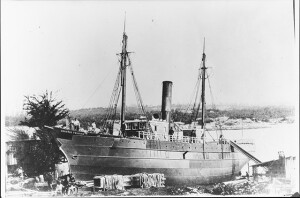 | 1883-1931 | Gussie Telfair (Screw steamer : 1866). | "Gussie Telfair" (1863-1880), ex "Gertrude" | Steamboats–United States. | Shows a port side view of the bow of a steamship hauled out of the water. | MS0091/03.02-02#1339 | |||
| 10 | 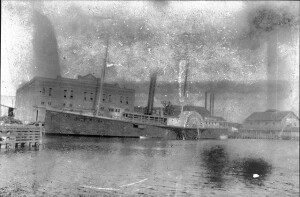 | 1883-1931 | Gussie (Side wheel steamer : 1872). | Charles Morgan + Company, "Gussie" 1872, later "Venezuela" (Ven.) | Steamboats–United States.; Paddle steamers–United States.; Harbors–United States. | Shows a port side view of a side wheel steamer moored in a harbor. | MS0091/03.02-02#1337 | |||
| 11 | No image URL. | USA | on recto: 12640. The Harbor, Key West., on verso: inscription: Gussie | View of a paddlewheel steamboat underway, head on toward camera. Inscription names it "Gussie." Another steamer is in the background. | MS0091/02.02-03#659 | |||||
| 12 | 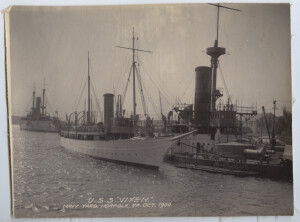 | 1901 | USA; VIRGINIA; NORFOLK | WRITTEN ON PHOTOGRAPH: U.S.S. WASP, NAVY YARD, NORFOLK VIRGINIA, OCTOBER 1901 | Bow view of ship at dock. USS Wasp (1898)From Wikipedia, USS Wasp at the Norfolk Navy Yard at Portsmouth, Virginia, on 19 November 1898. Career (United States) Name: USS Wasp Namesake: The wasp, a stinging insect Builder: William Cramp and Sons, Philadelphia, Pennsylvania Laid down: 1893 Launched: 1893 Completed: 1898 Acquired: 1898 Commissioned: 11 April 1898 Decommissioned: 1 December 1919 Struck: 13 November 1919 Fate: Sold 20 September 1921 Notes: Originally civilian yacht Columbia General characteristics Type: Armed yacht Displacement: 630 tons Length: 180 ft 0 in (54.86 m) Beam: 23 ft 0 in (7.01 m) Draft: 12 ft 0 in (3.66 m) Speed: 16.5 knots Complement: 55 officers and enlisted men Armament: 4 x 6-pounder guns 2 x Colt machine guns The seventh USS Wasp was an armed yacht that served in the U.S. Navy from 1898 to 1919 and saw service in the Spanish-American War. Acquisition and commissioning. It was built as the Columbia in 1893 by William Cramp & Sons for Joseph Harvey Ladew, Sr. modeled on the United States Coast and Geodetic Survey steamer Pathfinder. It was launched from Philadelphia, Pennsylvania on August 23, 1893.[1][2] It was used by the United States Navy, renamed USS Wasp, and commissioned at New York, New York, on 11 April 1898, Lieutenant Aaron Ward in command. Spanish-American War service.The converted yacht departed New York on 26 April 1898 and headed south for Spanish-American War duty blockading Cuba. She stopped at Key West, Florida, from 1 May 1898 to 7 May 1898 and arrived off Havana later on 7 May 1898. From there, she moved west along the northern coast to Bahia Honda, also arriving there on 7 May 1898. On 12 May 1898, while cruising on blockade station off the Cuban coast between Havana and Bahia Honda, Wasp joined a small convoy escorted by the revenue cutter USRC Manning and made up of merchantman SS Gussie and tugs Triton and Dewey. Gussie carried two companies of United States Army troops scheduled to land at Bahia Honda, while Triton and Dewey carried representatives of the press. Just before 1500 that afternoon, some of the soldiers from Gussie went ashore near Cabañas, purportedly the first American troops to land on Cuban soil. They formed a skirmish line and started their advance through dense underbrush. At about 1515, Spanish Army forces counterattacked the American troops and opened fire on the ships in the bay. Wasp returned fire with her portside six pounders, carefully avoiding the area occupied by friendly forces. At that point, she received word that the 100 or so soldiers fighting ashore were heavily outnumbered and outflanked to the west. The only course of action open to them was to disengage the enemy and reembark in Gussie. During that operation, Wasp joined Manning and recently arrived unarmored cruiser Dolphin in providing covering gunfire for the evacuation. When another landing, scheduled for the following day, did not occur, Wasp lobbed a few shells at an adobe watch-tower from which Spanish riflemen had taken the ships under fire, and then she resumed her patrol station off the coast. On 15 May 1898, the converted yacht departed the Cuban coast to return to Florida. She arrived at Key West that same day and remained in the Florida Keys, either at Key West or Sand Key, almost until the end of May 1898. Wasp returned to the blockade, at Cienfuegos, briefly on the 29 May 1898 but was back at Key West on 31 May 1898. During June 1898, the yacht moved from blockade station to blockade station, returning periodically to the Florida Keys for necessities. From 9 June 1898 to 11 June 1898, she stood off Havana. After a three-day return to Key West, Wasp took station off the southeastern coast of Cuba on 20 June 1898, patrolling between Santiago de Cuba and Guantanamo Bay. At the beginning of July 1898, she paid a five-day visit to Key West, returning to the Santiago de Cuba area again on 10 July 1898. On 19 July 1898, the converted yacht cleared Guantanamo Bay for Nipe Bay on Cuba's northeastern coast. She arrived at Nipe Bay late on the morning of the 21 July 1898 and, on orders to reconnoiter the bay in company with armed tug USS Leyden, started in toward Port Nipe. Upon entering, Wasp sighted a Spanish warship at anchor some four miles up the bay. She fired several shots at the signal station located at the entrance, then sped forward to engage the enemy ship. At 1244, the Spanish ship opened fire at extreme range, and Wasp returned fire immediately. Leyden, followed by gunboats USS Annapolis and USS Topeka, quickly joined in. As the range decreased, American gunfire became more accurate, and all four ships began scoring telling hits on the enemy. Finally, at 1312, the Spaniard's colors disappeared. Wasp and her three colleagues ceased fire and watched their quarry, the sloop Jorge Juan,[3] sink at 1342. After making a complete reconnaissance of the southern and western portions of the bay, Wasp anchored there for the night. On 23 July 1898, Wasp departed Cuba, bound for Puerto Rico, and arrived off Fajardo that same day. For the next seven weeks, she cruised the coasts of Puerto Rico in company with auxiliary cruiser USS Dixie, Annapolis, and gunboat USS Gloucester. Throughout the entire period, only one noteworthy event occurred. On 27 July 1898, the four ships encountered three Spanish brigantines at Ponce but evaluated them as too insignificant even to take as prizes. On 8 September 1898, Wasp departed San Juan to return to the United States. After a five-day stop at Charleston, South Carolina, she continued her voyage north on 18 September 1898 and entered the Norfolk Navy Yard at Norfolk, Virginia, on the 21 September 1898. On 27 September 1898, she was decommissioned there and laid up. Peacetime service on 15 December 1898, the yacht was loaned to the Florida Naval Militia for training purposes. That tour of duty lasted until 21 June 1899, at which time she was returned to the U.S. Navy. She resumed her retirement to serve as station ship at Port Royal, South Carolina. In July 1902, she returned to Norfolk to be decommissioned once again on 23 July 1902. On 2 October 1902, Wasp went into commission again and received orders to the 8th Naval District. During her service there as a district tender, she made infrequent cruises in the Gulf of Mexico and the West Indies. In 1906, she moved from the Gulf of Mexico to Newport, Rhode Island, for a tour of duty at the Torpedo Station. In 1907, she visited East Coast, Gulf Coast, and Mississippi River ports of the United States during a cruise to spur enlistments in the U.S. Navy. In 1908, Wasp began a nine-year assignment, again training naval militiamen, this time on loan to the New York Naval Militia. World War I Service that duty ended early in 1917, as the United States moved closer to war. On 7 April 1917, the day after the American declaration of war on the German Empire that brought the United States into World War I, Wasp began patrolling the coast of Long Island. Throughout the first year of the war, the yacht cruised the coastal waters of the 3d Naval District as a unit of, and later as flagship for, Squadron 8, Patrol Force. In April 1918, Wasp received orders detaching her from the 3d Naval District and assigning her to duty at Annapolis, Maryland. She arrived in Annapolis on 9 May 1918 and, but for periodic runs to Norfolk, remained there for the remainder of her naval career. Disposal struck from the Navy List on 13 November 1919, Wasp was formally decommissioned at Norfolk on 1 December 1919. On 20 September 1921, she was sold to Mr. Halsted P. Layton of Georgetown, Delaware. | MS0538/-02.01#083 |
Created 2026 by Don Barker, CBMM volunteer, for the Chesapeake Shipbuilding Project. shipbuilding@sailingworkboats.es